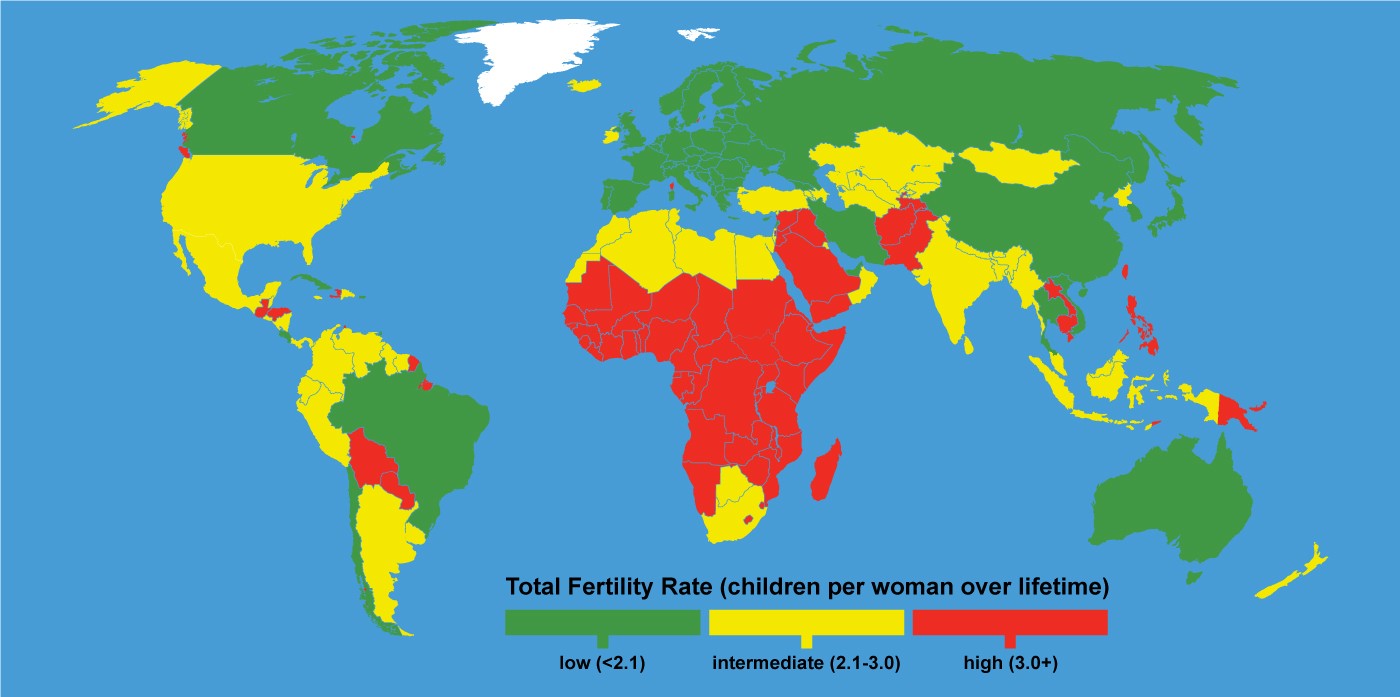
The reason is because there are too few people being born to grow up and make stuff so the people from 18-60 can buy it because the people over 60 are saving their money and retiring early -- and they spend their money on health care and necessities, having grown out of the need to get up early on Black Friday and fight over a cheap pillowcase just to get trampled. I'd call that progress, but the rest of the western world calls it pitiful and need of redressing. Even China and Japan and other industrialized nations are encouraging people to get busy and get pregnant -- many times.
That ties in with reports in Europe of why they are welcoming Muslim immigrants into the fold because they breed faster and can add the much needed children to grow up to be workers to support the growing numbers of elderly that burden their socialized governmental lives. It's a simple equation really. More young people working equals more money coming to the government to be dispersed to people who need it the most -- the elderly. And now the Muslim refugees who spurn the food given to them because they want money, money, money.
All those socialized countries are feeling the pinch -- or rather the sky falling -- because socialism and communism rely on a hard working population willing to give a substantial portion of their income to support the indigent, the poor, and the elderly. Oops! I'll bet that is why Obama, Pelosi, and Reid rushed to force the Affordable Care Act down American throats so they could invite immigrants from all over the world to come on in and take a piece of the socialized pie. I think that is how Argentina went bankrupt -- socialism and free good and services for all while more and more people piled on the free train and fewer and fewer children were born to take their place in the factories to give up their pay for the easy life of socialized medicine and other services.
I guess it's hard to see that your generosity is bankrupting the country and throwing everyone into the bread lines when you're having such a good time handing out the goods. The rich never feel the pinch what with tax loopholes and stealing from the poor to line their coffers with gold, gold, and more gold.
That is the problem. It's not that the desire to give is breaking the country's bank, but the need to get something for nothing which is the basis of socialism. Ayn Rand wrote in "Atlas Shrugged" about a company that went bust because of their implementation of their social program. Everyone worked according to their talents and everyone shared equally in the proceeds, except for those in the most need who got the lion's share of the proceeds. The owners never saw that the hardest workers were stiffed because more and more of their salaries were given to the people who had such bad luck and higher expenses, except that those that got the handouts kept having more emergencies, more bad luck, and more expenses. And how that philosophy of something for nothing spread. The Twentieth Century Motor Company imploded when the hardest workers decided they would no longer work for the neediest and instead went to other companies where their work was rewarded according to their production.
I see a variation of the same thing in the company where I work. It's not as cut and dried as the Twentieth Century Motor Company and I suspect the philosophy behind their policies has little to do with socialization or giving to the ones with the worst luck, greatest expenses, or most emergencies and more to do with treating the people who actually do the work and keep them in business like slaves. Every week I get to find out how much I make because there is no base rate or salary and errors and number of lines typed or edited in the course of the week vary from week to week. It's always a surprise -- a really nasty surprise.
What I have figured out is that the company keeps pay low for the people doing the work (that would be me and the other transcriptionists), forcing us to work extra hours and days to make up the difference between what we should be paid and what we actually are paid. In that way the company needs fewer employees and works the employees they have as hard as possible, spending the least amount on salaries. Of course, the company has to pay overtime unless the employee is making up time for the time lost because of low volumes of work, which is a cyclical problem in the industry. After all, other people get to take vacations and they tend to slow down production of reports during the holidays and summer so they can spend more time with their families. Not so the transcriptionist that is denied holiday pay or holidays and must make up the lost time and line counts on their own time, time they would spend with their families or cooking and baking or decorating the tree or any number of summer and holiday events and tasks.
The problem with this company is that they keep losing employees with experience, expertise, background, and knowledge because of their practices and have to replace these skilled and knowledgeable workers with kids fresh out of school or classes with only enough knowledge to be quickly overwhelmed and soon the proud owner of numerous written warnings about their performance. Of course, these young workers also make the least amount of pay because it is nearly impossible to make any money when your line counts are low and your accuracy is in the toilet (below 99%) when the company samples 1-5 reports a week and any error will send statistics into a death spiral.
In other companies where I've worked over the past 33 years in this business, statistics were based on errors counted over the course of a week and over the total numbers of lines, usually about 10,000 lines per week, and an error valued at 1 point or 3 points was offset by the volume. Hard to offset the volume when everything is based on 1 or 2 reports and adjusted according to the number of lines in the report, which usually falls below 100 lines. Oh, they adjust up if the report contains more than 100 lines, but the bulk of the work falls well below the 100 line mark.
The company, even though they gobble up as many smaller companies as they can, is beginning to suffer from their business practices by losing more and more experienced and knowledgeable workers and getting fewer and fewer beginners because fewer and fewer are being born and have any interest in legalized slavery. They'd rather chat on the iPhones and burn up the credit cards at the mall than work for a living if they can help it, especially for slave wages.
At least the upper management are happy because their profits keep growing, although for how much longer is the question. They will implode soon because the word is out that this company is not a good employer and treats their workers with contempt and disrespect. There are still a few small companies out there and some hospitals and clinics still have transcription department in-house where they guarantee good wages, great benefits, paid holidays and sick leave, and a decent vacation package.
The point of this is that falling birth rates, the holy Grail of zero population growth so prevalent in the 1960s and 1970s, is costing the economy, the government, and socialized services, which is why countries are welcoming Muslim immigrants breeding like rabbits with multiple wives to cover the shortfall. I wonder if the countries will survive the onslaught of refugees long enough to realize the benefit of higher birth rates. I guess we'll see.
The Zero Population Growth movement was because of the worry over dwindling resources, but that was before socialized health care, Welfare, and other socialized services went into effect and many countries climbed on the socialized band wagon.
Socialism is like opening a bank that gives out free money. At first, the plan works well. There are enough people depositing and making money to give away, but then more people find out about it. They tell their friends. News services pick up the story and broadcast it nationwide. Then the international news services get the story and broadcast it all over the planet. People come from everywhere to take advantage of the free money, descending in hordes until they overwhelm the bank and the system and there are not enough savers and workers to put anything back into the program. The services slow down, the bank collapses, and a good idea dies with a nuclear bang that leaves a big black hole into which the country falls. And still more people arrive to take advantage of the free money even though there is no more and, angered at being promised so much only to find it gone, they riot and destroy everything in their path because they didn't get their share. That is the future of socialism and the countries that embraced it with righteous fervor.
That may be the future of the world and it is not a pretty picture. The day looms closer every minute -- destroyed by generosity. It is anyone's guess which will implode first, socialism or natural resources.
That is all. Disperse.


